


How To Read A Supplement Label In 60 Seconds
The 60-second version
Five things, in order.
Serving size. Active ingredients. Amount per serving. Other ingredients. The claim and its fine print.
Turn the box over. Every supplement sold in the US carries the same panel, and once you know the five things on it, you can read any brand's label in about a minute. Ours included.
Most of us skip straight to the front of the box, where the pretty words live. The back is where the facts live. It's printed in tiny type, which is usually a sign it's worth reading.
Our source is the NIH Office of Dietary Supplements, part of the National Institutes of Health. Its consumer guide, Dietary Supplements: What You Need to Know, was last updated in January 2023. Then, at the end, we'll turn one of ours over and read it with you.
Why the back of the box matters
Here's the part most people don't know. "Medicines must be approved by FDA before they can be sold or marketed," the NIH guide explains. "Supplements do not require this approval."
Instead, "supplement companies are responsible for having evidence that their products are safe," and their label claims have to be truthful and not misleading.
The term natural doesn't always mean safe.
NIH Office of Dietary Supplements
So the label is your best tool. Sixty seconds with it tells you more than any front-of-box promise.
The five things on every supplement label
Read them in this order. Each one comes from the NIH guide.
- 01Serving size. How much counts as one dose: two gummies, one scoop, one packet. "The manufacturer suggests the serving size," NIH notes, "but your health care provider might decide a different amount" is right for you.
- 02Active ingredients. The Supplement Facts panel "lists the active ingredients." These are the reason the product exists. If the front of the box names an ingredient, find it here.
- 03Amount per serving. The dose of each active ingredient. Next to it you'll often see % Daily Value. A dagger (†) means no Daily Value has been set for that ingredient, so look at the amount itself.
- 04Other ingredients. Usually printed below the panel. NIH lists what you'll find here: fillers, binders and flavorings. This is where sweeteners and anything you avoid will show up.
- 05The claim and its fine print. A label can say a product "promotes health or supports a body part" or function. When it does, it has to carry this line: "This statement has not been evaluated by the Food and Drug Administration. This product is not intended to diagnose, treat, cure, or prevent any disease."
See a seal from USP, NSF or ConsumerLab.com? It means the product passed that group's quality testing. NIH is clear that "these seals do not guarantee that a product is safe or effective."
Now turn ours over
Fair is fair. Here's the back of our Super Beauty Elixir, the original Glotrition, read the same way.

Serving size: 1 packet (7.2 g). 30 servings per box, so one box is one month.
Active ingredientsVerisol® bioactive collagen peptides, hyaluronic acid, biotin, vitamin C and an antioxidant blend.
Amount per serving: 2,500 mg Verisol®. 150 mg hyaluronic acid. 300 mcg biotin. 12 mg vitamin C. 522 mg antioxidant blend.
Other ingredients: Palatinose™ (isomaltulose), natural flavors, malic acid, stevia extract and silicon dioxide.
The fine print": Take one packet daily to get the clinically studied dose of Verisol® Bioactive Collagen Peptides®." Then the FDA line: "These statements have not been evaluated by the Food and Drug Administration. This product is not intended to diagnose, treat, cure, or prevent disease."
A few things worth pointing out, because you'd notice them anyway.
The 1000% next to biotin. That's a Daily Value percentage. 300 mcg is ten times biotin's Daily Value of 30 mcg. If you take other supplements, add up what's in all of them, and tell your health care provider everything you take. NIH recommends exactly that.
The antioxidant blend. A blend lists its ingredients and its total weight, not the amount of each one. Ours names all five: blueberry fruit extract, blueberry juice powder, tart cherry concentrate powder, cranberry powder and resveratrol, at 522 mg combined.
The safety line. Our pouch says to consult a physician "if you are pregnant, nursing or are taking any medications." That's the same advice NIH gives for any supplement.
The 2 g of sugar. That comes from Palatinose™, listed under other ingredients. It's 25 calories a packet.
We've been in beauty supplements for more than 10 years. We show you the back of our box because we'd want you to read it before you trust us. The same goes for everyone else's.
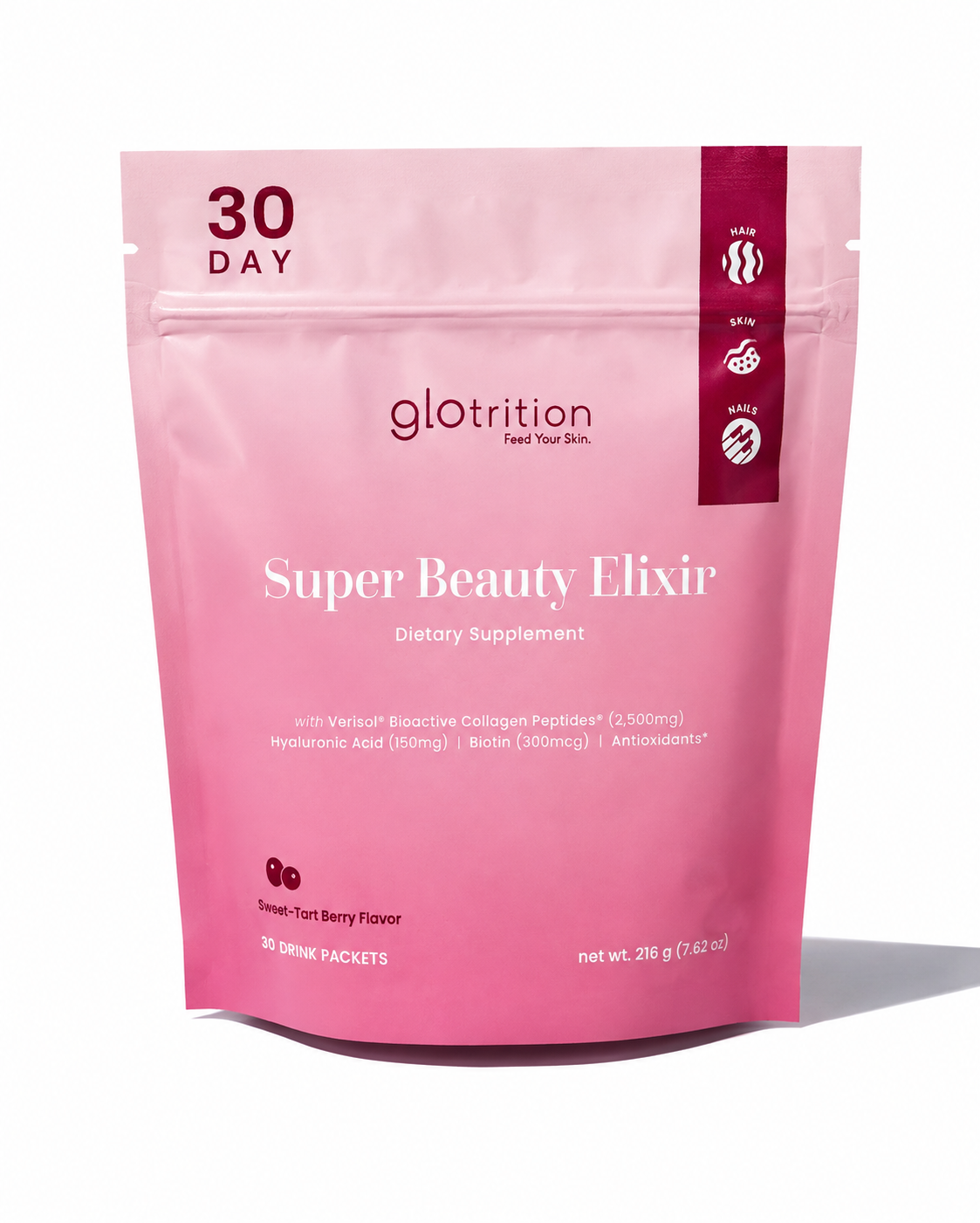
Super Beauty Elixir
The original Glotrition. 2,500 mg of Verisol® collagen peptides in every packet, mixed into 20 oz of water. Read the label, then decide.
Shop Super Beauty ElixirQuick answers
Are supplements approved by the FDA?
No. Medicines need FDA approval before they're sold. Supplements don't, and companies are responsible for having evidence that their products are safe.
What does the dagger (†) mean on a supplement label?
No Daily Value has been established for that ingredient. Read the amount per serving instead.
What is a proprietary blend?
A group of ingredients listed with one combined amount, instead of an amount for each.
Does a quality seal mean a supplement works?
No. Seals from USP, NSF or ConsumerLab.com show a product passed quality testing. NIH notes they don't guarantee a product is safe or effective.
Does "natural" mean safe?
Not always. NIH points to comfrey and kava, natural botanicals that can harm the liver.
xo, Glotrition
Source: NIH Office of Dietary Supplements, Dietary Supplements: What You Need to Know, updated January 4, 2023. Label details are from our Super Beauty Elixir Supplement Facts panel.
Small Daily Rituals. Big Results.
Build your inside-out beauty routine with clinically backed collagen support. One stick a day, visible results in 8 weeks.